Why the 323i doesn't have a 2.3L engine, and there's no throttled-down 2.5L either
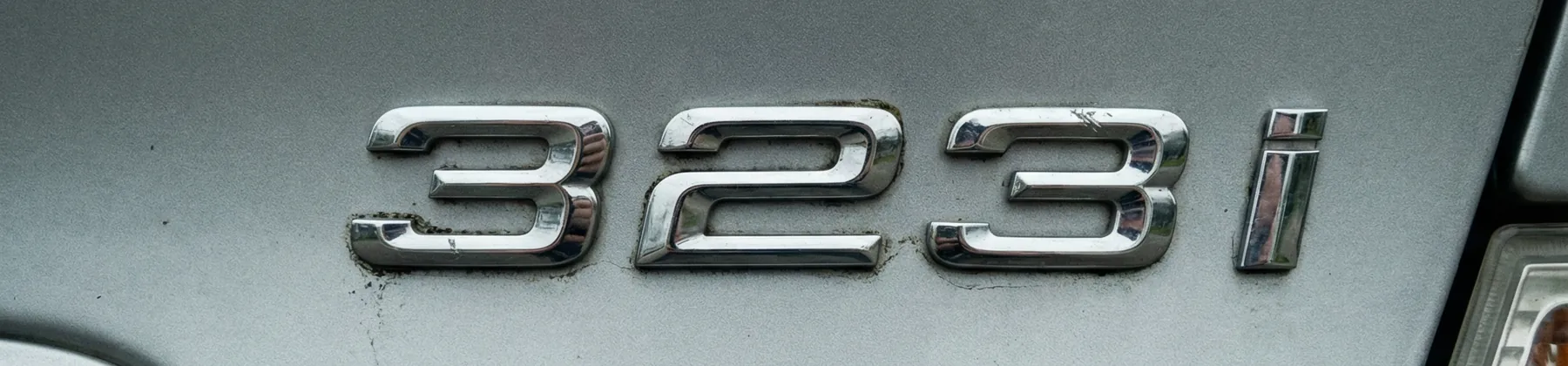
If I got a penny for every time someone tried to convince me that the BMW E36 or E46 badged as 323i has a 2.3 litre engine, I'd probably be a millionaire by now.
It's not hard to understand why people keep saying it. After all, even BMW itself stated on their website for a while that this should be the case — until they noticed their mistake and quietly deleted the whole page. Because BMW invents naming conventions specifically so they can break them immediately afterwards, as you can read in detail in the article about The Non-Existent BMW Model Naming Convention and its history.
So while many people have already come to terms with the fact that, for example, the BMW 750i E38 is not 5.0L but 5.4L, or that the BMW E60 525d actually has a 3.0L engine, the model that has for some mysterious reason become one of the most misunderstood is the 323i / 523i.
To be more precise, we're talking about the generations with the chassis codes E36, E46 and E39. Let's take a closer look at their specs and actual data:
| Model | Engine code | Displacement | Power |
|---|---|---|---|
| E36 323i | M52B25 | 2,494 cc | 125 kW / 5500 rpm |
| E36 323ti (Compact) | M52B25 | 2,494 cc | 125 kW / 5500 rpm |
| E36/7 2.3i (Z3) | M52TÜB25 | 2,494 cc | 125 kW / 5500 rpm |
| E46 323i | M52TÜB25 | 2,494 cc | 125 kW / 5500 rpm |
| E39 523i | M52B25 / M52TÜB25 | 2,494 cc | 125 kW / 5500 rpm |
The engine code already makes it obvious there's no 2.3L variant here. B25 quite clearly says: petrol, 2.5L — as if the actual displacement didn't already make it obvious enough.
It gets even more absurd with the BMW Z3, where the model is literally called 2.3i despite the engine still being the 2.5L. However, given the relatively small production numbers of the Z3, it's much harder to run into someone who'd earnestly try to convince you about the non-existent engine.
Where did this myth come from?
Ironically, BMW itself created it. If you've already read the aforementioned article about non-existent conventions and rules that exist solely to be broken, it must already be clear to you that once again it was everyone's favourite marketing department that was behind it.
The official explanation was that although the newly introduced M52 engines in the BMW E36 are more modern than the M50 engines they replaced, specifically the 2.5L versions produced less power — and therefore the model names should reflect that.
So the existing BMW E36 325i with the M50 engine producing 141 kW received, after the facelift, a direct successor in the form of the BMW E36 323i with the M52 engine producing 125 kW.
OK, that almost makes sense. However, with the BMW E46 and E39, there's a completely incomprehensible turn of events. During the production of these models, BMW introduced new M54 engines (which are in practice closer to revised M52s), replacing the M52.
The "stronger" 2.5L M54B25 engine returns to the lineup, and the models now receive the badge 325i/525i depending on the body. Yet inexplicably, the existing 320i/520i with the M52B20 producing 110 kW is replaced by a model with the EXACT SAME NAME 320i/520i — now producing 125 kW, but with an M54B22 engine, meaning 2.2L.
This is precisely where it would have made roughly a hundred times more sense to call the model with the M54B22 engine — if not 322i (BMW has an aversion to certain combinations) — at least 323i.
The "throttled-down 2.5"
Once we've settled the question of what's under the bonnet of the 323i/523i, there almost inevitably appears someone considerably "smarter" who adds another fun phrase to the conversation — "Well, it's a throttled-down 2.5, that 323i…"
As I mentioned, BMW itself adjusted the name for marketing reasons to signal a weaker model, and this is most likely where the second myth originates — the idea that some existing 2.5L engine was artificially throttled to produce less power.
This argument, however, always mysteriously falls apart when I ask: "And which 2.5L did they throttle?"
Why? Simple. Let's recall the BMW E36, where the M52B25 made its debut, and where simultaneously the model 325i with the M50B25 engine producing 141 kW was also sold. That engine had — among many other differences — a cast iron block, unlike the M52, which already featured an aluminium block. These are not the same engine, and it makes no sense for the later variant to be a throttled version of it. The more knowledgeable among us also know that the M50 had a larger intake manifold that can be swapped onto the M52 and is used as a relatively straightforward way to increase power — which is perhaps exactly where this confusion originates.
I might grudgingly accept that argument if we were only talking about the E36, but this claim is most often made specifically about the E46 and E39, where it makes absolutely no sense. No M50 engines were ever offered in the E46 or E39, so there was nothing to "throttle" — the stronger M54B25 came after the M52B25, so it too couldn't have been throttled beforehand.
A far more accurate — though equally nonsensical — claim would be that it's a "throttled 2.8L", since the blocks share the same bore, meaning you can convert a 2.5L to a 2.8L relatively easily by swapping the crankshaft. Of course this conversion isn't quite that simple — the crank alone doesn't make a B25-to-B28 conversion, since there are also differences in pistons, the cylinder head, ECU, intake, exhaust and so on. Nonetheless, the B25 and B28 blocks are identical, and the B25 is simply the lower-output variant of the M52B28.
And yet, a 2.3L engine does exist!
To wrap up, I'd like to note that BMW really did produce two models with an inline-six displacing 2.3L. These were the M20B23 engines found in the BMW E21 323i and later the BMW E30 323i, and one four-cylinder of the same displacement — the BMW S14B23 used in the BMW E30 M3.